Guide to Bespoke African Safari Holidays
Almost every safari operator will tell you their trips are tailor-made. Very few of them mean it in a way that changes what happens at six o’clock in the morning.
The difference between an ordinary safari and a bespoke one is not the thread count. It is whether the vehicle turns left because you want it to. Most of what follows is a set of decisions taken months before you arrive, and each of them either hands control to you or takes it away.
Reading Progress
Jump to a section:
9 min read
Berkeley Team
This is not a guide to how a safari works. If you have not been before and want the practical side, start with our first-time safari guide instead. This piece is about what you are actually buying when you pay for the top of the market.
What Makes a Safari Truly Bespoke?
Four things, in order of how much they change the experience.
The vehicle is private. On a shared game drive you travel with up to five strangers and the sighting belongs to the group. Someone wants to sit with the leopard for an hour. Someone else has photographed leopards before and would rather find wild dogs. Someone needs to be back for breakfast. A private vehicle removes the negotiation entirely, and it is the single most effective thing you can spend money on.
The guide is yours. Camps rotate their guides. A private guide who travels with you across three camps knows by the second day whether you want the technical explanation or the silence, and can plan the week around what you have already seen rather than starting fresh each time.
The camp is small, or it is yours. Six rooms behave differently from twenty. And an exclusive-use camp, taken in its entirety, behaves differently again: no other guests, no fixed mealtimes, no waiting.
The itinerary answers to you. Set departures move on a schedule. A bespoke itinerary can hold you an extra night because the wild dogs have denned nearby, or move you early because the water has drawn game elsewhere.
Private Guides, Trackers and Exclusive-Use Camps
The southern African tradition pairs a guide at the wheel with a tracker on a seat mounted over the front left wing. The tracker reads the ground: which way the tracks point, how fresh they are, whether the animal was walking or hunting. Watching a good tracker work is one of the genuine pleasures of a safari in the Sabi Sand, and it is a skill that takes years.
Singita Boulders works this way, on the Sand River in the Sabi Sand. So does Singita Lebombo and its smaller neighbour Singita Sweni, on a private concession inside Kruger.
For exclusive use, Singita Castleton is the one we book most. It is taken as a whole house with its own guide, tracker, vehicle and chef, which makes it the obvious answer for a family group, a milestone birthday, or two couples travelling together who would rather not share a dining table.
There is a practical point here that gets missed. On a shared vehicle with six guests, the guide is managing six sets of expectations. On a private vehicle, the guide is managing yours. The quality of guiding does not change. What changes is who it is aimed at.
Fly-In Access and Why It Matters
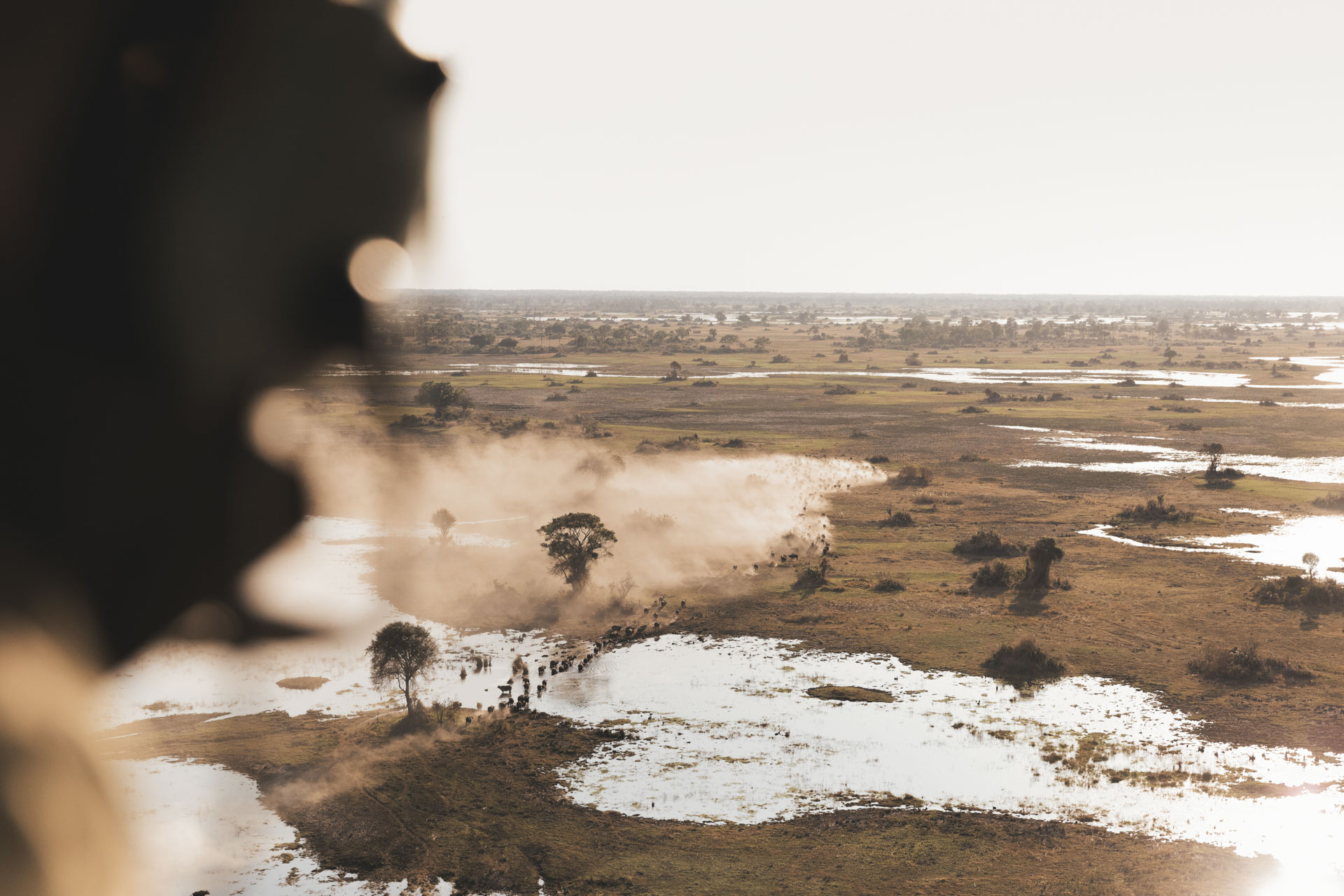
In Botswana, flying is not a luxury. The Okavango Delta has very little road, and the camps are reached by light aircraft as a matter of course. Wilderness Mombo sits on Chief’s Island in the heart of the Delta, and there is no sensible way to arrive except from the air.
Elsewhere the calculation is about time. A road transfer that takes six hours takes fifty minutes in a Cessna. Over a ten-day itinerary with three camps, flying rather than driving gives you back the better part of two days, and those days are game drives rather than dirt roads.
The trade-off is luggage. Light aircraft in Botswana and Tanzania typically restrict you to a soft-sided bag with no frame, usually around twenty kilograms including hand luggage, and the limits are enforced. Your travel designer will confirm the exact allowance for your aircraft, and can arrange for the rest of your luggage to be held and returned to you at the end of the bush leg.
For groups, or where scheduled light-aircraft timings waste a morning, a private charter puts you into the camp airstrip on your own schedule.
Building an Itinerary Around You
A few things become possible once the trip is genuinely yours, and most people do not know to ask for them.
Off-road driving. Private reserves and private concessions permit vehicles to leave the road network and follow an animal. National parks generally do not. This is why the Sabi Sand has the leopard reputation it does, and it is the most important structural difference between a private reserve and a public park.
Night drives. Permitted in private reserves and concessions, restricted in national parks. Genets, civets, bushbabies and, if you are fortunate, a leopard hunting are all night animals.
Walking safaris. Requires a specially qualified guide and a rifle, and changes the scale of everything. Tracks you drove past at thirty kilometres an hour become an hour of reading the ground on foot.
Sleep-outs. A star bed or a fly camp, one night away from the lodge, with the same team.
Photographic support. Vehicles with beanbags and camera mounts, a guide who understands light, and drives timed to the sun rather than the breakfast service. Worth requesting specifically if photography is the point of the trip.
The shape of the day. There is no rule that says you must do two drives. Some of the best mornings involve leaving at five and staying out until noon with a cool box, rather than returning for a brunch you did not want.
Combining Ecosystems: One Trip, Several Kinds of Wild
The most common mistake on a first bespoke safari is spending nine nights in one kind of country. Africa’s interest lies in how different its wildernesses are from each other. Three camps in three ecosystems will stay with you longer than three camps in the same one.
Delta and floodplain. The Okavango, at Mombo or Eagle Island, where a mokoro at water level is a different animal entirely from a game drive.
Dry riverine bush. The Sabi Sand and the Kruger concessions, where the predator density is highest and the sightings are closest.
Open savannah. Singita Grumeti in the western Serengeti, a private concession of enormous scale on the migration route.
Desert. Sossusvlei Desert Lodge in Namibia, among the highest dunes in the world, where the wildlife is sparse and the landscape does the work.
Forest. Bisate in Rwanda, for mountain gorillas, which is a different discipline from game viewing altogether.
Coast. Kisawa Sanctuary on Benguerra Island, an hour’s flight from the Kruger region, which is why bush and beach became the classic combination in the first place.
Two ecosystems in ten days. Three in fourteen. More than that and you spend the holiday in transit.
Rare Encounters Worth Timing a Trip Around
If your dates are flexible, a handful of events are worth building the trip around rather than hoping to catch.
The Mara River crossings, when the migration herds cross between the Serengeti and the Masai Mara, generally from around July into October. The crossings themselves are unpredictable to the day and can involve long waits.
Calving season on the southern Serengeti plains, roughly late January into March, when several hundred thousand wildebeest give birth within a few weeks. The predator activity that follows is extraordinary, and it is far less visited than the river crossings.
Wild dog denning, in the southern African winter, when a pack stays fixed at a den site for weeks rather than ranging over enormous distances. Wild dogs are Africa’s most efficient predator and among its most difficult to find. A known den is the closest thing to a guarantee.
Gorilla trekking in Rwanda, which runs year round but is easier underfoot in the drier months.
Timing a trip around any of these needs to happen early. The camps that sit in the right place at the right time are small, and they are held a year or more in advance.
Comfort Without Compromise: Cellars, Spas, and the Space Between Drives
A safari day has a hole in the middle of it. You are out at first light, back for brunch, and not out again until four. What a camp does with those five hours is a fair test of how serious it is.
The best answer is usually that it does very little, but does it beautifully. A plunge pool in your own room, a hide at eye level with the waterhole, a bed positioned so you can watch the ground from it. Singita’s properties are known for their wine, with cellars stocked well beyond what a camp four hours from a road has any obligation to offer.
The point is not that a camp is comfortable. Almost all of them are at this level. The point is that comfort should not have cost you anything in the wild. The moment a camp feels like a hotel that happens to be surrounded by bush, something has gone wrong.
You can see the properties we rate most highly in our list of the best five-star hotels in Africa.
What Booking Through Berkeley Adds
We hold preferred partner status with a number of the groups behind the camps on this page. That gives our clients benefits not available through public booking channels: preferred rates, room upgrades subject to availability, and VIP recognition on arrival. The full list is on our trusted partners page.
More usefully on a safari specifically, our travel designers have stayed in these camps. That is what allows us to tell you which of two rooms at the same camp has the better view of the waterhole, and which of two camps in the same reserve suits the way you actually want to travel.
Once the itinerary is set, our concierge team handles the connections, the charters and the ground arrangements either side of the bush.
Frequently Asked Questions
A package safari fixes the route, the camps, the vehicle and the group before you book. A bespoke safari fixes none of them. In practice the differences that matter most are a private vehicle rather than a shared one, a guide who travels with you rather than rotating, and the freedom to change the itinerary while you are there. Browse our safari itineraries to see the range.
Twelve months for peak season, and longer if you want a specific camp or exclusive use. The camps at this level have between six and twelve rooms, so a single family group can take half a property. For the migration river crossings or a denning season, book as early as you are able. Shoulder-season travel can sometimes be arranged within six months.
Yes, and it is often a better trip. South Africa with Botswana, or Kenya with Tanzania, or a safari followed by gorillas in Rwanda. The constraint is flight connections rather than distance, and this is where the routing work earns its keep. Two countries in fourteen days is comfortable. Three is usually one too many.
An exclusive-use camp is booked in its entirety by one party, with its own guide, tracker, vehicle and kitchen team for the duration. A shared lodge takes individual bookings, so you share the common areas and, unless you have paid for a private vehicle, the game drives. Exclusive use makes most sense for family groups, multi-generational travel and milestone celebrations.
Allow from £1,500 to £2,500 per person per night at the top camps, fully inclusive of game drives, meals and drinks. The bespoke elements sit on top: a private vehicle and guide typically adds several hundred pounds per day and is the spend that changes the trip most, while an exclusive-use camp such as Singita Castleton is priced as a whole property rather than per room. For a ten-day itinerary across two or three camps with light-aircraft transfers, most of our clients invest from around £30,000 for two people.

Speak to a Travel Designer
The camps described here are small, and the best of them are held a long way out. If you have dates in mind, the conversation is worth having early.
Related Posts
6 min read
Belmond Bellini Club: What It Is, What You Get and How to Book
Book a Belmond hotel, train or safari lodge through a Bellini Club agency and the stay comes with breakfast, a credit, an upgrade and recognition at the same rate as going direct. Our guide to the programme, the properties it covers and how Berkeley Travel books it.
5 min read
Four Seasons Resort Tangier: Morocco’s Next Great Address
Four Seasons has confirmed its fourth Moroccan property, a cliffside resort above the Strait of Gibraltar in Tangier’s Cap Malabata. Here is everything announced so far, what it signals about northern Morocco, and how Berkeley Travel’s Preferred Partner status will apply when it opens.
5 min read
British Airways’ New A380: Nearly Half the Plane Is Now Premium
British Airways has revealed its refurbished A380, with new First suites, 106 Club Suites and a premium economy cabin a third larger. Our Travel Designers on what the most premium-heavy aircraft in the sky means for your next long-haul flight.
YOUR DEDICATED TRAVEL PARTNER
24
/
7
/
365
TAILORED SERVICES
TAILORED SERVICES
Our in-house concierge service will use their extensive contact list
to help you source anything you desire.
TAILORED SERVICES
Our in-house concierge service will use their extensive contact list
to help you source anything you desire.
BESPOKE itinerary
BESPOKE itinerary
We work hand in hand with clients to create your dream
itinerary ensuring every detail is looked after from start to finish.
BESPOKE itinerary
We work hand in hand with clients to create your dream
itinerary ensuring every detail is looked after from start to finish.
BESPOKE AIR
BESPOKE AIR
We have access to every major airline and an extensive knowledge of their pricing schedules helping our clients achieve highly competitive airfares in all cabins.
BESPOKE AIR
We have access to every major airline and an extensive knowledge of their pricing schedules helping our clients achieve highly competitive airfares in all cabins.
PRIVATE SKY
PRIVATE SKY
Working directly hand in hand with our brokers and
aircraft owners we can source the best deals and most convenient slots for Private Jet hire.
PRIVATE SKY
Working directly hand in hand with our brokers and
aircraft owners we can source the best deals and most convenient slots for Private Jet hire.
EXCLUSIVE BENEFITS
EXCLUSIVE BENEFITS
We have arranged with a number of our luxury partners some exclusive additional benefits. These can include complimentary daily breakfast, a hotel credit towards food or spa treatments,an upgrade on arrival where available, and early check in / late check out.
EXCLUSIVE BENEFITS
We have arranged with a number of our luxury partners some exclusive additional benefits. These can include complimentary daily breakfast, a hotel credit towards food or spa treatments,an upgrade on arrival where available, and early check in / late check out.
COST MANAGEMENT
COST MANAGEMENT
We provide access for our clients to the most cost effective and convenient travel means. Our long standing partnerships and in depth industry knowledge ensure that we source the best rates available on the market.
COST MANAGEMENT
We provide access for our clients to the most cost effective and convenient travel means. Our long standing partnerships and in depth industry knowledge ensure that we source the best rates available on the market.

London office suite